


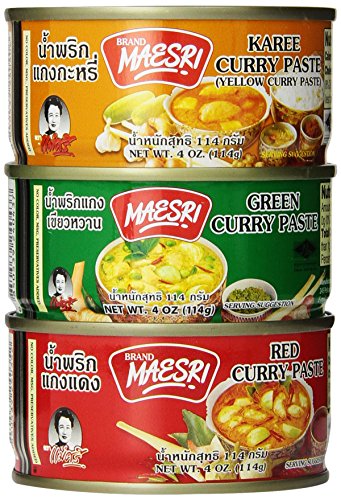

Thai Green Red Yellow Curry Pastes Set (Original Version), 4 Ounce (Pack of 6)
$13.40
Brand: MAESRI Brand
- 2 can (4 oz.) Green Curry Paste
- 2 can (4 oz.) Red Curry Paste f
- 2 can (4 oz.) Yellow Curry Paste
- No Color, MSG, Preservatives Added
- Direction on the can, easy to follow. A wonderful food lover gift.
Discover more from MenuCulture
Subscribe to get the latest posts sent to your email.
5 reviews for Thai Green Red Yellow Curry Pastes Set (Original Version), 4 Ounce (Pack of 6)
Add a review
Related products

Arborist Merchandising Root


Baking Chocolates, Carob & Cocoa

l2 –
If you haven't tried this, I recommend doing so. Easy to make and taste great!
l2 –
The Red and Green are spicier than is comfortable for my pale taste, but I still like it. I have not made the yellow which is supposed to be the mildest and is what I like the most at restaurants. The meals are so easy to make which is great. The printing on the cans are tiny, so beware that each can has its own amount of coconut milk in the recipe. Just use any extra in a nice frappe. Yes, what the people in Thailand consider medium is an inferno to me, so even the mild gives me a runny nose and this proves it is authentic Thai food.
Bryan A. –
These are great curry pastes. The taste is great and I love the fact they are not so salty compared to some other brands.
Amazon Customer –
We bought this set of cans in August 2020. The expiration date on them in August 2022, two years in the future. We go through 1 or 2 cans a month, so the expiration date is no problem.
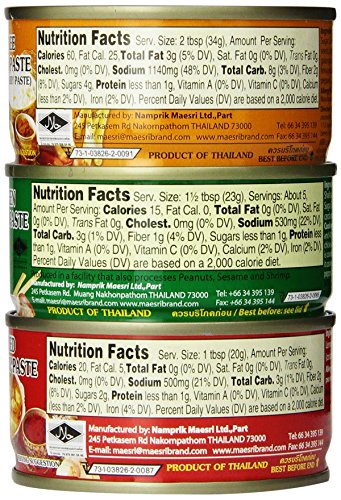
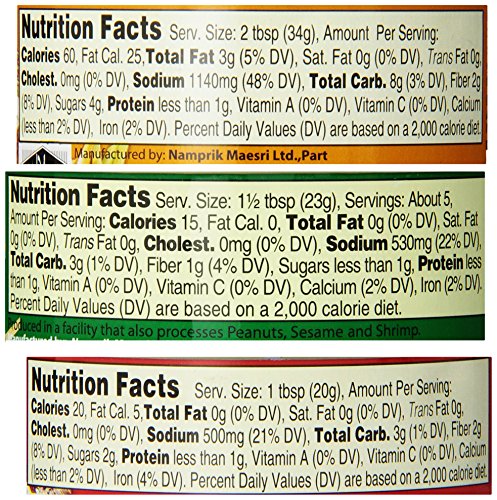
Curiously, the nutritional label on our cans is quite a bit different from the product description (see photo). The product description recommends 34, 23, or 20 grams per person (depending on curry type). The label on our cans says 17, 16, or 20 grams per person. That's a big difference for the yellow and green pastes. The serving size is important not just for the flavor, but also the sodium level which is a huge 1140mg for the yellow sauce with the old labels but only 570mg with the new labels. Over 1000mg of sodium in one serving is not healthy, especially if you are also adding fish sauce like most recipes recommend. One tablespoon of fish sauce can contain another 1000mg of sodium.
Our general recipe for a healthy Thai curry is to use half a can of the curry paste and 1 can of coconut milk for 4 servings. Refrigerate the other half can of curry paste for next time. We use 1 pound of sliced meat (usually chicken, beef, or pork) and 1 pound of vegetables (whatever we have handy; could be broccoli, carrots, bell peppers, bamboo shoots, string beans, chopped cabbage, etc) for 4 servings. Curry microwaves well, so we make 4 servings even for 2 of us and refrigerate the leftovers.
To boost the flavor of the curry paste, we saute it for a couple of minutes with half a large sliced onion and a couple of garlic cloves. Then add one can of coconut milk and simmer the meat and vegetables until the meat is cooked through (10 to 15 minutes). Add fish sauce to taste, but no more than 1 tablespoon for 4 servings because we don't want to boost the sodium content too much. Garnish with whole basil leaves and sliced chilli peppers to add some more flavor as well as aroma.
Coconut milk is rich and tasty, but one 13 ounce can is 700 calories of saturated fat. We eat the curry with rice, but not a huge amount. The 1 pound of vegetables in our curry recipe adds nutrition and reduces the amount of rice we need to add to each meal.
Amazon Customer –
These are some good canned Thai curries. Take a look at the ingredients and you'll find that they are pretty much entirely aromatic veggies/fruits, roots, spices, salt… and that's about it (the yellow curry has some oil). It's a great alternative to mashing up the same ingredients in a mortar and pestle for an extended period of time, especially if you augment the canned paste with some fresh aromatics like garlic, ginger, lemongrass, lime juice, basil etc. I'm fairly convinced that most Thai takeout restaurants in the US use this type of product, because it tastes very similar to what I get from most Thai takeout restaurants that I have ordered from in the US. I received one dented can, but I just used that can first. Good product.